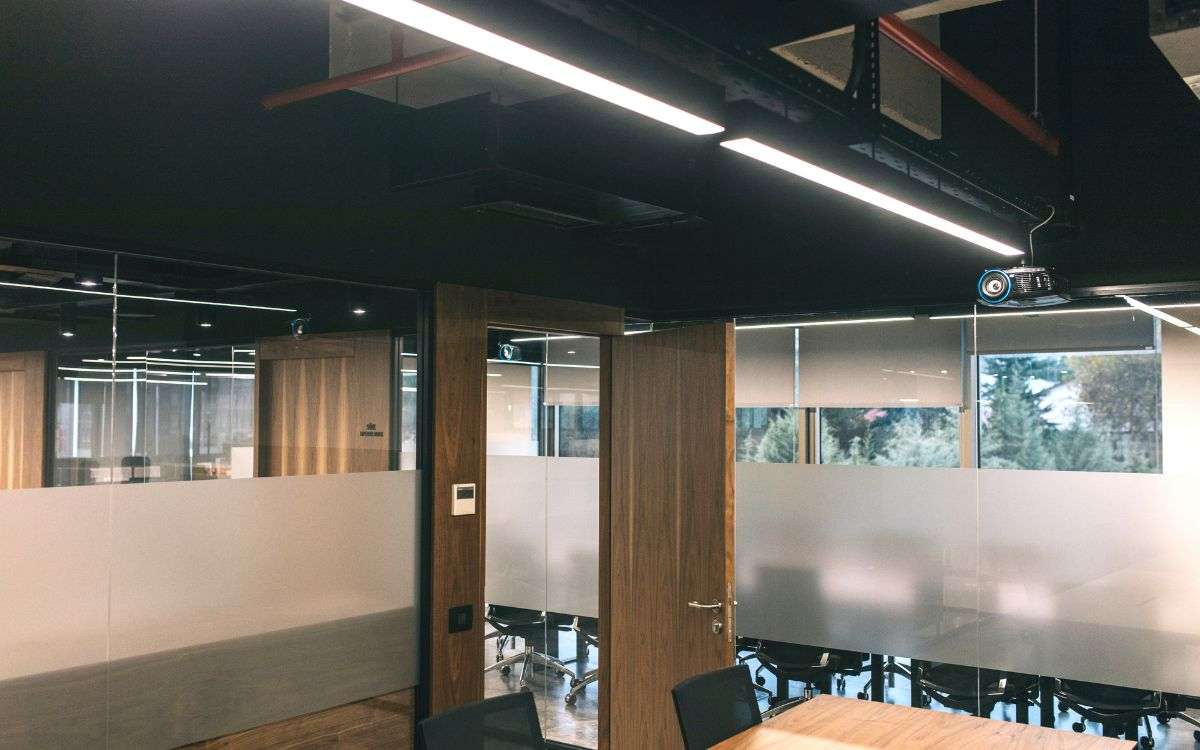
The operations director of a technology company in Madrid noticed a worrying pattern. His team was complaining of headaches and tired eyes on an almost daily basis.
A lighting professional who visited the office found that the ceiling panels had a UGR of 28, well above the acceptable level for a working environment with screens. They replaced all the luminaires with models featuring UGR19 office LED and Philips driver.
Within two weeks the complaints disappeared. Three months later the lighting received a positive score in the workplace climate survey for the first time.
Sometimes a company's biggest productivity problem is on the ceiling. And the solution is to understand what UGR lighting is and why it should matter to you just as much as wattage or lumens.
What UGR means and how it is calculated
UGR, or Unified Glare Rating, is the parameter that measures the visual discomfort a luminaire causes to the user. It is not about luminous intensity, but about how the light is emitted and in which direction. A low value indicates greater visual comfort. A high value signals that the luminaire is producing excessive unified glare.
The UGR formula explained without jargon
The formula takes into account the surface luminance of the light source. The background against which it is perceived. The shielding angle and the position of the observer. In practice, what you need to know is this:
- Low values between 13-16: the light is barely perceived as a direct source. Maximum comfort.
- Medium values between 17-19: suitable for prolonged work with screens or concentration tasks.
- High values between 22-28: obvious discomfort. It causes fatigue and reduces visual efficiency.
It depends on the geometry of the space, the mounting height and the reflectances of walls, floor and ceiling. But manufacturers calculate the value under standardised reference conditions, and that is the figure that appears on the technical data sheet.
Why the EN 12464 standard requires it to be controlled
The EN 12464 standard, the European standard for interior workplace lighting, sets maximum UGR limits for each type of activity. It is not a recommendation: it is a requirement that installations must meet. The UGR standard for offices establishes a maximum of UGR 19 for workstations with computer screens.
In healthcare and educational environments it drops to UGR 17.
In retail areas with products that require maximum visual perception, the limit falls to UGR 13.
Ignoring these values causes discomfort and can constitute a regulatory breach in occupational health and safety audits.

Recommended UGR values by type of space
Choosing the right luminaire starts with knowing the maximum UGR your space requires. The difference between UGR13 UGR17 UGR19 determines which product you need and what level of visual comfort you will achieve.
| Space |
Maximum UGR |
Typical Application |
| Offices and coworking spaces |
19 |
Screen-based work |
| Classrooms and libraries |
17 |
Prolonged reading |
| Hospitals and clinics |
17 |
Examinations and consultations |
| Shops and retail |
13 |
Product display |
| Technical drawing rooms |
16 |
Fine visual detail |
UGR19 for offices and screen-based work
The standard for offices. A certified UGR19 LED panel ensures that workers do not perceive annoying glare when looking up from their screens. UGR and worker visual comfort are directly linked, as below 19 the perception of wellbeing improves noticeably. Above that threshold, complaints of eye strain soar.
UGR17 for clinics and classrooms
In healthcare environments, lighting with high glare can interfere with medical examinations and lead to errors. The UGR17 LED downlight for clinics is the solution for consulting rooms, waiting areas and laboratories. In classrooms, UGR17 allows pupils to read for hours without excessive fatigue and enables the teacher to work in front of the whiteboard without uncomfortable reflections.
UGR13 for shops and commercial spaces
UGR13 for commercial retail is the most demanding level. In retail, lighting must highlight the product without disturbing the customer. A UGR13 track spotlight with suitable optics creates clean lighting accents without the shopper perceiving the light source as aggressive. Fashion, jewellery and food shops benefit the most from this level of control.
How UGR affects wellbeing and productivity
The relationship between UGR LED lighting and work performance is well documented. We are talking about measurable indicators that impact the bottom line of any company.
Visual fatigue and absenteeism: real data
Studies by the INSST link eye strain caused by glare with a 12-15% increase in sick leave due to headaches in poorly lit office environments. Workplace performance and lighting have a direct impact on employees. Those working under luminaires with a UGR above 22 report 25% more interruptions due to visual discomfort than those working under UGR19 or lower.
The hidden cost of poor office lighting
A company with 50 workstations that loses 15 minutes per worker per day to visual fatigue is burning through more than 3,000 productive hours a year. That far exceeds the cost of replacing the panels. And that is without counting sick leave, emotional wear and staff turnover. Why UGR matters at work stops being a theoretical question when you translate the numbers.
How to identify whether a luminaire has a low UGR
Not all LED luminaires sold as anti-glare truly deliver. Knowing how to measure a luminaire's UGR saves you disappointment after installation.
Where the UGR figure appears on the technical data sheet
The UGR value should appear on the product's technical data sheet, usually alongside figures such as lumens, watts, CRI and colour temperature. If it is not there, be wary. A genuine anti-glare LED luminaire specifies the UGR under reference conditions. Look for the full UGR table showing the value according to the room dimensions and reflectances.
What ENEC certification means for LED panels
ENEC lighting certification is the European safety mark for luminaires. An ENEC-certified UGR LED panel has been tested by a laboratory that validates both electrical safety and the declared photometric data, including UGR. It is the most reliable way to ensure that the figure you see on the data sheet is not a number made up by the manufacturer.

Products with certified UGR for every space
Knowing the theory is fine. But what you need are specific products that meet these requirements in your installation. Genuine glare-free LED lighting requires luminaires designed from the outset to control light emission. Not simply diffusers that dim the lumens and lose energy efficiency.
UGR19 LED panels for offices
60x60cm panels recessed into suspended ceilings are the standard format for offices. A good certified UGR19 LED panel offers:
- UGR below 19 under real office conditions.
- CRI above 80, though 90+ is far better.
- Dimmable driver compatible with DALI systems.
- Efficacy above 100 lm/W.
- ENEC certification with a full photometric report.
UGR17 downlights for healthcare and educational use
The low-UGR LED downlight with recessed optics achieves UGR17 values without sacrificing luminous output. Models with a wide shielding angle are the most effective for medical consulting rooms and classrooms where the user frequently looks towards the ceiling.
UGR13 track spotlights for retail
In shops, the UGR13 track spotlight with precision optics creates clean accents on the product without the light beam assaulting the customer. Models with an integrated honeycomb and faceted reflector are the best at controlling lateral spill and maintaining the spotlight effect without glare.
Frequently asked questions about UGR in LED lighting
What UGR value do I need for my office?
UGR 19 maximum. This is the limit set by the EN 12464-1 standard for workstations with computer screens. If your office has low ceilings or the luminaires are very close to the field of vision, it is worth looking for products with an even lower UGR.
Is it compulsory to comply with UGR requirements in workspaces?
Yes. The EN 12464 standard is mandatory for new installations and refurbishments in Spain. Non-compliance can be detected during occupational health and safety inspections and result in corrective action orders.
Do all LED panels have their UGR specified?
No. Many budget panels do not include this figure or declare it without laboratory backing. Always look for products with ENEC lighting certification or photometric reports from an accredited laboratory.
Can a low-UGR luminaire have fewer lumens?
Not necessarily. Good optical design controls glare without reducing light output. Luminaires that simply darken the diffuser to lower the UGR lose efficiency. Those that use micro-prismatic optics or internal reflectors maintain lumens with controlled UGR.
Does UGR affect everyone equally?
Sensitivity varies according to age, pre-existing visual conditions and the type of task. People with presbyopia or light sensitivity tend to notice the effects of glare sooner. That is why the standard sets conservative values that protect the widest possible range of users.
How can I improve the UGR of an existing installation?
The most effective option is to replace the luminaires with models that have certified UGR. If that is not feasible in the short term, anti-glare louvres or micro-prismatic diffusers can be added to the existing panels, although the improvement will be partial. Reorienting desks so that luminaires are not within the direct field of vision also helps to reduce the perception of glare.
Leave a comment