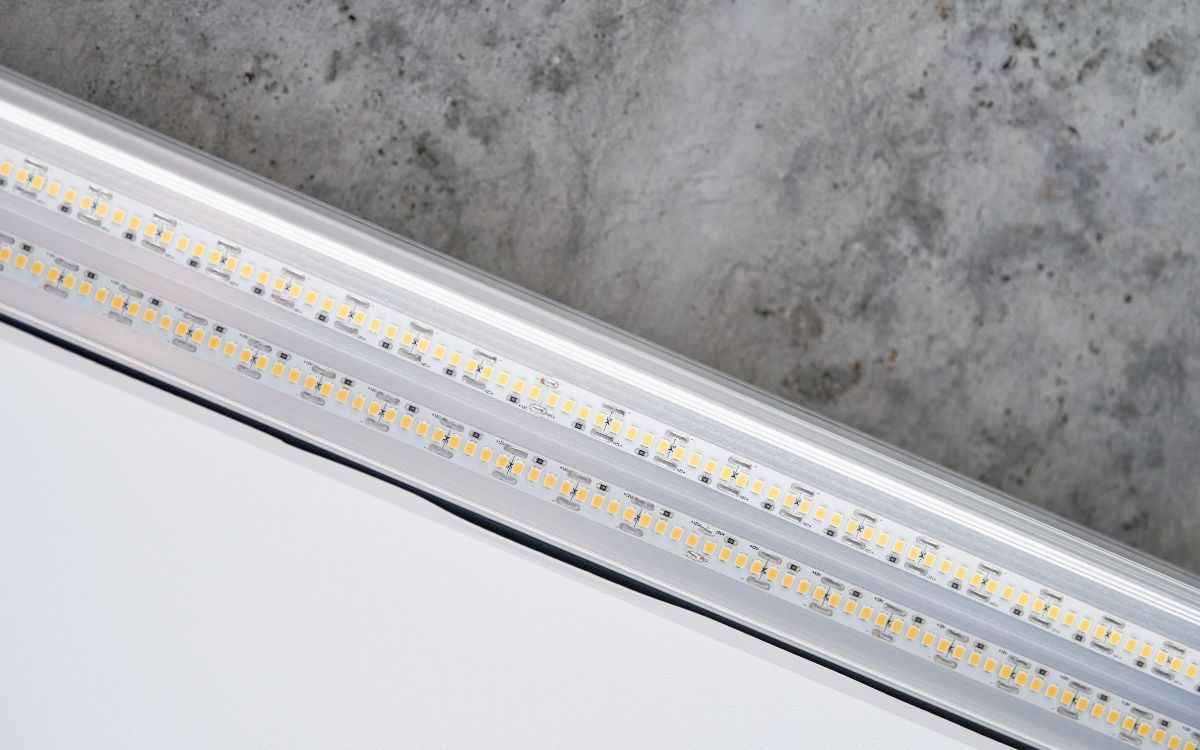
A couple renovated their flat's kitchen and decided to add lighting under the cabinets. They bought COB LED strips, stuck them onto the wooden surface of the unit and for two weeks the result seemed perfect. Then the problems started: hot spots on the surface, the adhesive peeling off and intermittent flickering.
The installer who came to fix it explained to them that without an aluminium profile, the strip has nowhere to dissipate the heat. He fitted a 2-metre aluminium LED strip profile under each kitchen unit and everything was sorted.
That story happens more often than you might think. The profile seems like a secondary accessory, but it is the component that determines whether your aluminium LED strip profile installation will last years or cause problems.
What an aluminium profile does in an LED installation
An aluminium profile serves three functions that go well beyond the decorative. Understanding them explains why it is an investment that protects the entire installation.
Mechanical protection for the LED strip
The LED strip is a flexible and delicate circuit. It is left exposed to knocks, scuffs, dust and accidental handling. The profile acts as a rigid casing that protects the electronic components and solder points. In a kitchen cabinet aluminium LED profile, this protection is essential because the work area concentrates grease, steam and constant movement.
Heat dissipation and strip lifespan
LED strips generate heat, and if that heat is not dissipated, the chips degrade and the lifespan decreases. Aluminium heat dissipation is up to ten times more efficient than sticking the strip onto wood or plastic. A good profile can extend the strip's life from 15,000 to over 50,000 hours.
Professional finish with no visible light spots
A strip stuck on without a profile shows each individual LED as a bright spot that is unpleasant to look at. With a diffuser over the profile, those spots disappear and the line of light becomes continuous. This is the reason that most convinces the domestic user. A dot-free LED strip profile transforms a home installation into something rather more professional.

Types of profile by mounting system
There is a profile for every situation. The choice depends on where you are going to install it and what visual result you are after. These are the four most common types of aluminium LED profile.
Surface-mounted profile: the most versatile and easiest to install
It is screwed or adhered directly onto any flat surface: ceiling, wall, inside a cupboard or shelving unit. The surface-mounted aluminium LED strip profile is the most popular option due to its simplicity. The surface fixing method is achieved with mounting clips or industrial double-sided tape. Its anodised silver finish fits into most settings without looking out of place.
Recessed profile for false ceilings and plasterboard
The recessed aluminium LED strip profile is inserted into a routed channel in the surface. The result is a line of light flush with the material. It is widely used as a plasterboard recessed LED profile in ceiling and partition renovations.
It is also the go-to choice for recessed false ceiling profiles in offices, hotels and shops. The finish is clean and elegant, but it requires more preparation work.
Walk-over floor profile: strength and safety
The walk-over aluminium floor LED profile features a thicker, mechanically stronger diffuser, designed to withstand pedestrian traffic. It is used in corridors, staircases and route signage in commercial premises. Its reinforced diffuser supports weight without deforming or losing light transmission.
45-degree corner profile for recesses and furniture
The 45-degree corner LED profile projects light diagonally, ideal for illuminating cupboard recesses, display cabinets or wall-to-ceiling junctions. Also known as a corner angled profile, it offers a very attractive light distribution on shelving units and bathroom furniture.
For installations requiring greater visual impact, the suspended hanging LED profile is fixed to the ceiling with cables, creating floating lines of light that work very well in reception areas and open commercial spaces.
Diffusers: opal vs transparent
The diffuser is the piece of opal polycarbonate or transparent material that covers the strip inside the profile. Its choice directly affects the final lighting result.
When to use an opal diffuser for uniform light
The aluminium profile with opal diffuser is the most recommended for the majority of projects. The reason is simple: it completely eliminates the visibility of individual LEDs and produces a homogeneous line of light. Perfect for lighting kitchens, bathrooms, bedrooms and passageways. The loss of luminosity ranges between 15% and 25%, a trade-off that is almost always worthwhile for the visual comfort it provides.
When to use a transparent diffuser for maximum luminosity
If you need every available lumen — for example, in a technical application or a display cabinet that demands maximum intensity — the transparent diffuser maintains practically 100% of the luminous flux. But it leaves the LED spots more visible. The decision between an opal vs transparent LED strip diffuser depends on whether you prioritise aesthetics or raw output.

How to choose the right profile for each LED strip
Not all profiles are suitable for all strips.
Profile width according to the strip's millimetres
The LED strip profile width must be equal to or greater than the width of the strip. Standard strips measure 8 mm or 10 mm, but high-power strips can reach 12–15 mm. Measuring before you buy will save you returns and frustration.
Compatibility with COB and SMD strips
Which profile should you use for a COB LED strip? In principle the same as for SMD, provided the width matches. LED strip and profile compatibility depends solely on the physical dimensions. COB strips have the advantage of producing a continuous line of light even without a diffuser. The profile is still necessary for heat dissipation and mechanical protection.
Bear in mind the maximum strip run without a cut that your power supply can handle in order to plan your sections properly.
Step-by-step installation
Knowing how to install an aluminium LED strip profile is a straightforward process if you have the right tools.
Tools required
- Mitre saw or hand saw with an aluminium blade.
- Drill with a masonry or wood bit (depending on the surface).
- Tape measure, pencil and spirit level.
- Fixing clips or industrial adhesive.
- Scissors or craft knife to cut the LED strip.
Fixing and cutting the profile
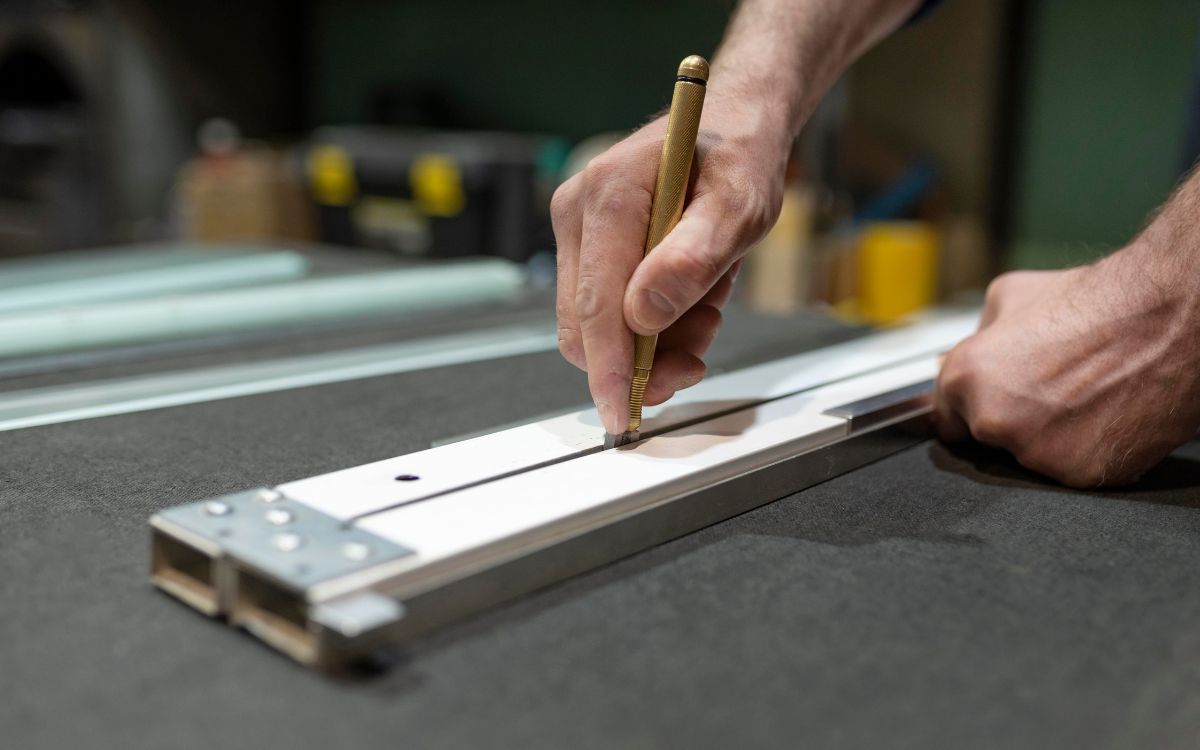
Measure the exact run and cut the profile with a mitre saw for a clean finish. Fix the mounting clips to the surface every 30–40 cm and snap the profile into place. Fit the profile end caps at each end for a professional closure. Profiles are usually sold in 2-metre aluminium LED strip profile lengths, sufficient for most domestic applications.
Inserting the strip and making the connection
Remove the backing from the strip's adhesive, stick it inside the profile channel and press down gently. Connect the wiring to the power supply, fit the diffuser and check the result. If everything is properly aligned, the line of light will be continuous and uniform.
As for the aluminium LED profile price, it varies depending on the type and length. Surface-mounted profiles start from under five pounds per one-metre length, whilst recessed and walk-over profiles are slightly more expensive due to their manufacturing complexity.
Frequently asked questions about aluminium profiles for LEDs
Is it compulsory to use an aluminium profile with an LED strip?
It is not compulsory, but it is highly recommended. Without a profile, the strip loses its dissipation capacity, degrades more quickly and the finish is visibly worse. For strips exceeding 10W/m it is considered practically essential.
Which profile do I need for a 10 mm LED strip?
A profile with an internal channel of at least 12 mm wide. That leaves enough room to insert the strip without forcing it and allows good adhesion to the base of the channel.
Can I cut aluminium profiles to size?
Yes. They are easily cut with a mitre saw or a hand saw with a metal blade. Use a fine file to smooth the edges and remove any burrs.
Does the opal diffuser significantly reduce the strip's luminosity?
It reduces between 15% and 25% of the luminous flux. In return, it eliminates individual light spots and produces a uniform line that is far more pleasant to the eye.
Which profile should I use to light the underside of a kitchen cabinet?
The surface-mounted profile is the most practical option. It is screwed or adhered under the cabinet, remains discreet and protects the strip from the steam and grease in the cooking area.
Are aluminium profiles suitable for outdoor LED strips?
Standard profiles are designed for indoor use. For outdoor applications you need profiles with an IP65 protection rating or higher, featuring silicone sealing on the end caps and diffuser to prevent water and dust ingress.
Leave a comment