LED lighting for sports facilities demands more care than any other lighting project. Sports spaces are not lit like an office. The player needs to see the ball without glare, the referee must follow every play and the audience has to enjoy the match. This guide explains the regulations, the light levels and the LED solutions.
Why sports lighting has different requirements from other spaces
In sport, light influences the result. A fast-moving ball can only be followed well if the light is uniform and stable. That is why sports lighting is calculated with its own parameters, such as the light uniformity of the court, the glare control for players and the type of competition.

Athlete safety and spectacle quality
Poorly distributed light causes shadows and dark areas where the ball gets lost. That increases the risk of injury and worsens the game. Flicker is another problem, because it tires the eyes and shows up on cameras.
Regulations and illuminance levels by type of use
The regulations for sports facility lighting in Europe rely on the UNE-EN 12193 standard, which deals with the lighting of sports facilities. This standard sets the sports illuminance levels according to the sport and the class of the facility. The recommended lux for a sports facility change from one sport to another, so each project must consult the table for the specific sport.
The standard defines three lighting classes. Class I is for high-level competitions and high-performance training. Class II corresponds to medium-level competitions and performance training. Class III covers simple competitions, general training, school sport and recreational sports practice.
The lighting class must be agreed in advance between the person who designs and the person who operates the facility. Looking at the lux regulations for federated sport, each federation may ask for a specific level to approve the field for its competitions. This is part of the CIE regulations and federations, which are consulted before deciding the power.
Training vs competition: differences in requirements
Between training and competition the class changes and, with it, the light level required. General training allows a lower class. An official match with spectators calls for a higher class.
If the driver allows intensity regulation between training and competition, the same installation serves both uses and uses less energy.
Additional requirements for television broadcasting
In sports venues with cameras, new requirements appear. The CIE sports lighting regulations include guide CIE 083:2019, which covers the lighting of sports events for television and film systems. This guide gives guidance on vertical illuminance, uniformity, flicker, colour temperature and colour rendering.
The recent revision of the EN 12193 standard also raised the minimum colour rendering index and started to use the TLCI index for cameras. For LED lighting for sports TV broadcasting, it is advisable to choose an LED floodlight for broadcasting with no visible flicker in slow motion.
LED solutions by type of facility
In LED lighting for sports facilities there is no single floodlight for everything. The choice changes between indoor and outdoor and depends on the mounting height, the size of the court and the sport. Proper lighting requires attention to the light distribution on the court, that is, how each optic spreads the light.

Sports halls and covered multi-sport courts
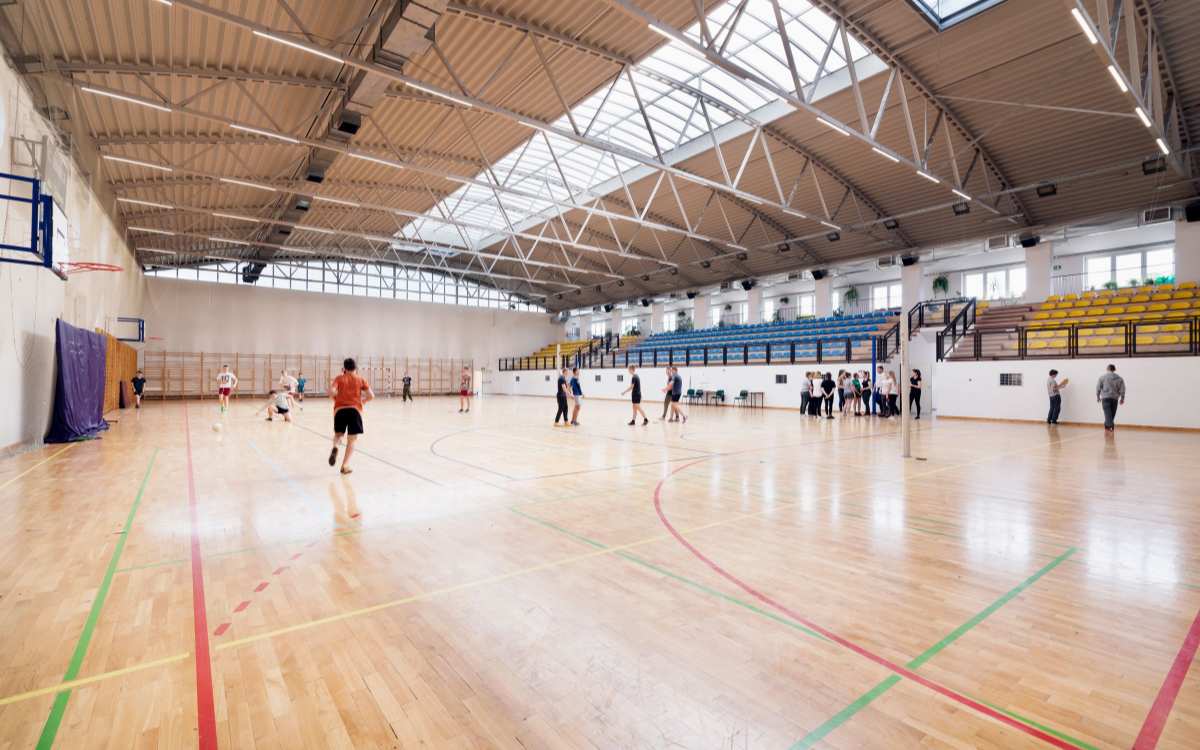
In a sports hall, the light falls from a certain height and the ball also goes up. That is why LED lighting for a sports hall seeks uniformity and little glare. An LED floodlight for a multi-sport court with suitable optics spreads the light evenly between the lines.
For a basketball court, an LED floodlight for a basketball court must avoid direct brightness when the player looks up. In every LED floodlight for an indoor sports court, the opening angle and the level of protection against ball impact are checked.
LED lighting for a gym is simpler. Visual comfort and regulation according to the activity matter here, from a gentle class to a strength workout.
Football and rugby pitches outdoors
Outdoors, LED lighting for a football pitch, like all pitch lighting, works with towers and high-power floodlights. On sports fields the aim is to cover the whole ground without shadow areas and without bothering the neighbours with spill light. For federated competition, the federated installation certification requires checking that the light meets what the corresponding federation demands.
In higher-level stadiums, an LED floodlight for a competition stadium adds power, narrow optics and flicker control. At Icilux you can see the Matrix series LED spotlights and floodlights for stadiums, designed for this use. There are also outdoor LED floodlights for smaller facilities.
Padel and tennis courts
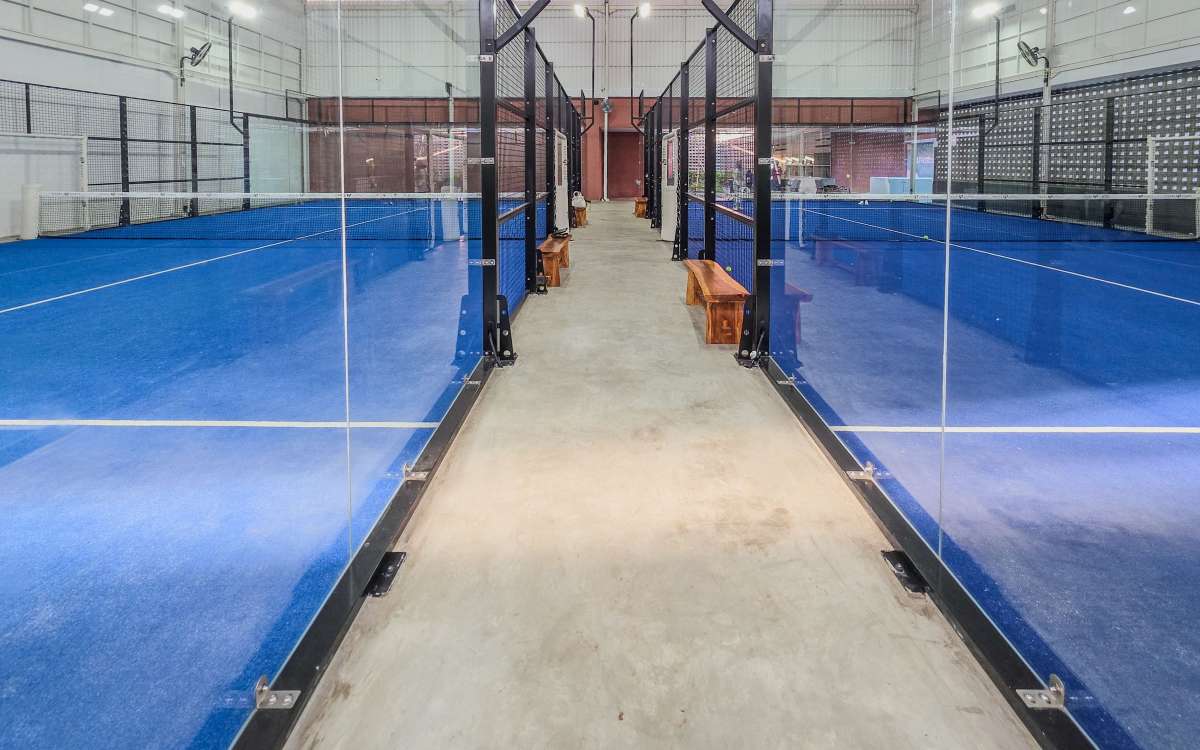
A small court is demanding, because the player looks at the ball upwards and to the sides. LED lighting for a padel court must avoid reflections on the glass and spread the light on all four sides. In tennis something similar happens, with the addition of the baselines.
Sports swimming pools
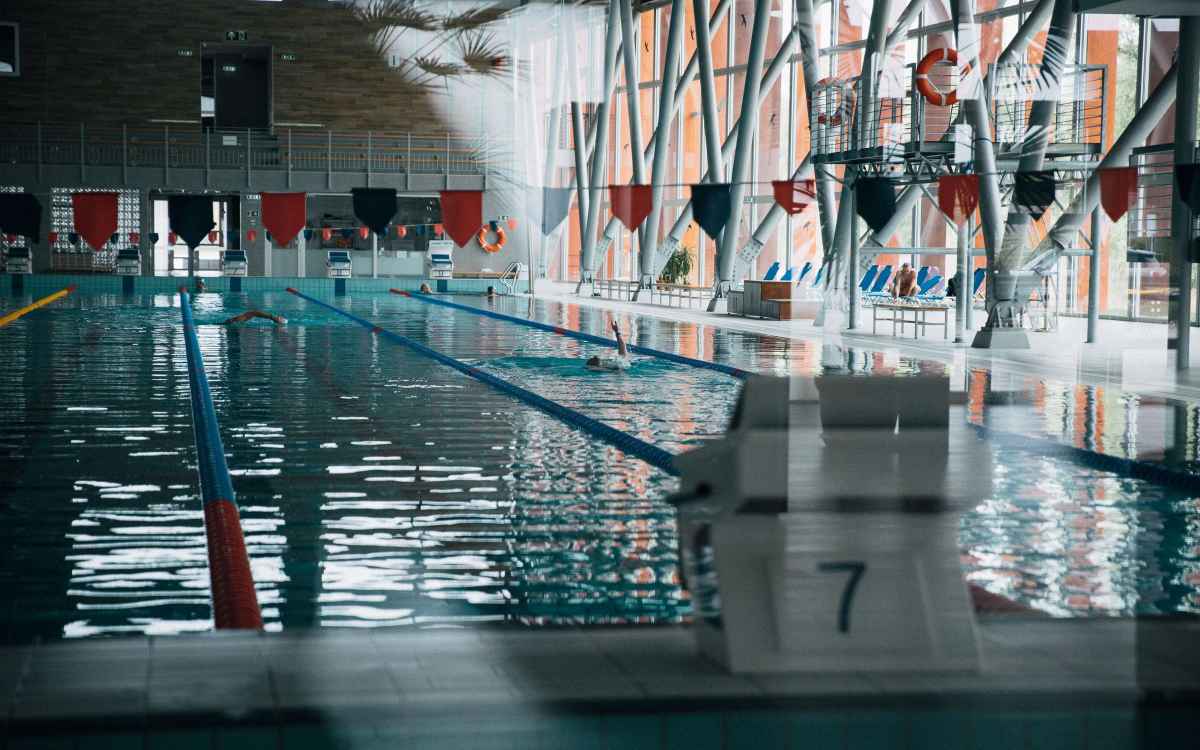
LED lighting for a sports swimming pool has an added challenge, which is the reflection on the water. It is solved with a good position of the floodlights and with optics that do not dazzle the swimmer or the judge. Humidity and chlorine also call for a good degree of protection, so the IP rating of the equipment should be checked.
Essential technical parameters in sports floodlights
Before buying LED lighting for sports facilities, look at three data points on the datasheet. They are uniformity, glare control and the type of driver.
Light uniformity and controlled glare
Uniformity compares the darkest areas with the average of the court. Without uniform lighting, the player notices changes of light when moving. Glare is controlled with narrow optics, shields and a good orientation of the floodlights.
Dimmable driver to adapt intensity to use
The driver is the component of the light source that weighs most in energy savings and in lifetime. A Philips Xitanium floodlight for sports includes a dimmable driver with good reliability, and it allows lowering the power in training and raising it in matches. In our opinion, it is the strongest argument in favour of LED over metal halide.
The energy efficiency of a sports facility improves clearly with this regulation, because it reduces energy consumption to what the installation needs at each moment. You can see the LED drivers for LED luminaires available in the shop.
How to plan LED lighting for sports facilities with guarantees
A good LED lighting project for sports facilities starts with three questions. What sport is played, at what level and with what audience. From there comes the lighting class, and from the class come the levels the installation must reach.

Then a lighting study of the lighting system is requested from a specialist. The study calculates how many floodlights are needed, at what height they go and how they are aimed.
The price of an LED floodlight for a sports facility depends on the power, the optics, the driver and the quality of the components.
A football club in Castilla y León wanted to renew the light of its pitch without losing the weekend match. With a dimmable driver it was able to train with the light at half power and keep the maximum for matches.
Power calculation according to the dimensions of the facility
The total power depends on the surface, the mounting height and the light level required by the chosen class. That is why the lighting study is the most important step, before talking about models.
Frequently asked questions about LED lighting in sports facilities
How many lux does a football pitch need for federated competition?
It depends on the lighting class and the category of the competition. The UNE-EN 12193 standard sets the values and each federation may require a specific level. The recommended approach is to ask the federation for its requirement and calculate it in a lighting study.
What is the difference in lighting between training and an official match?
The lighting class changes. General training allows a lower class and the official match calls for a higher class, especially if there are spectators or cameras.
Are LED sports floodlights suitable for television broadcasting?
Yes, if they meet the requirements of guide CIE 083:2019 and show no flicker on camera. It is advisable to check the driver and the colour rendering before choosing the model.
What regulations govern the lighting of sports facilities in Spain?
The UNE-EN 12193 standard applies, which is the Spanish version of the European standard. To it are added the requirements of each federation and, for broadcasts, the CIE guide.
How much is saved by replacing metal halide floodlights with LED in a sports hall?
The saving depends on the hours of use and the installed power. With a dimmable driver less energy is used in training, and a prior study allows the figure to be estimated for each case.
Can the intensity of the floodlights be adjusted according to the type of use?
Yes, with a dimmable driver. It is the usual solution to adjust the light between training and competition without changing equipment.
Leave a comment