The maintenance manager of a logistics company in Guadalajara presented a report to management on switching to LED lighting. The figures were clear: 68,000 euros in annual electricity savings, 12,000 in maintenance, and a return on investment in 16 months. Management approved the project within a week. What started as a technical project became an argument for efficient management.
In many companies, the greatest opportunity for business LED lighting savings has been switched on in the ceiling for years, waiting for someone to take notice.
How much does a company save with LED?
It depends on the installation, but typically between 50% and 70% of consumption, plus what is no longer spent on maintenance.
Why 2025 is the best time to switch to LED
Two factors make the financial case for LED stronger today than three years ago: the price of electricity and tightening regulatory requirements.
Business electricity price per kWh in 2025
The business electricity price in 2025 under a 3.0TD tariff fluctuates between 0.14 and 0.22 €/kWh depending on the period and type of contract. For companies with average contracted capacity, the mean cost is around 0.17 €/kWh including network charges, levies, and the variable market component.
Business lighting electricity costs can represent between 20% and 40% of the electricity bill in office buildings or industrial installations. If the current installation consumes more than necessary, every excess kWh has a real, measurable cost.
Tightening energy efficiency regulations
The European Energy Efficiency Directive (EED, revised in 2023) requires companies to audit and progressively reduce their consumption. At the same time, the Ecodesign Regulation withdrew T8 and T5 fluorescent tubes from the market from August 2023. Companies still operating with fluorescents are not only paying more on their bills but also finding it increasingly difficult to source replacements. The switch is no longer an optimisation decision; it is becoming a matter of operational continuity.
Furthermore, reducing the lighting carbon footprint is a growing argument for companies with sustainability targets or ESG audits. LED lighting can reduce emissions associated with lighting energy consumption by more than 60% compared to discharge technologies.

How much your current lighting actually consumes
Before calculating savings, you need to know what you are paying. The cost per hour of operation varies considerably depending on the installed technology.
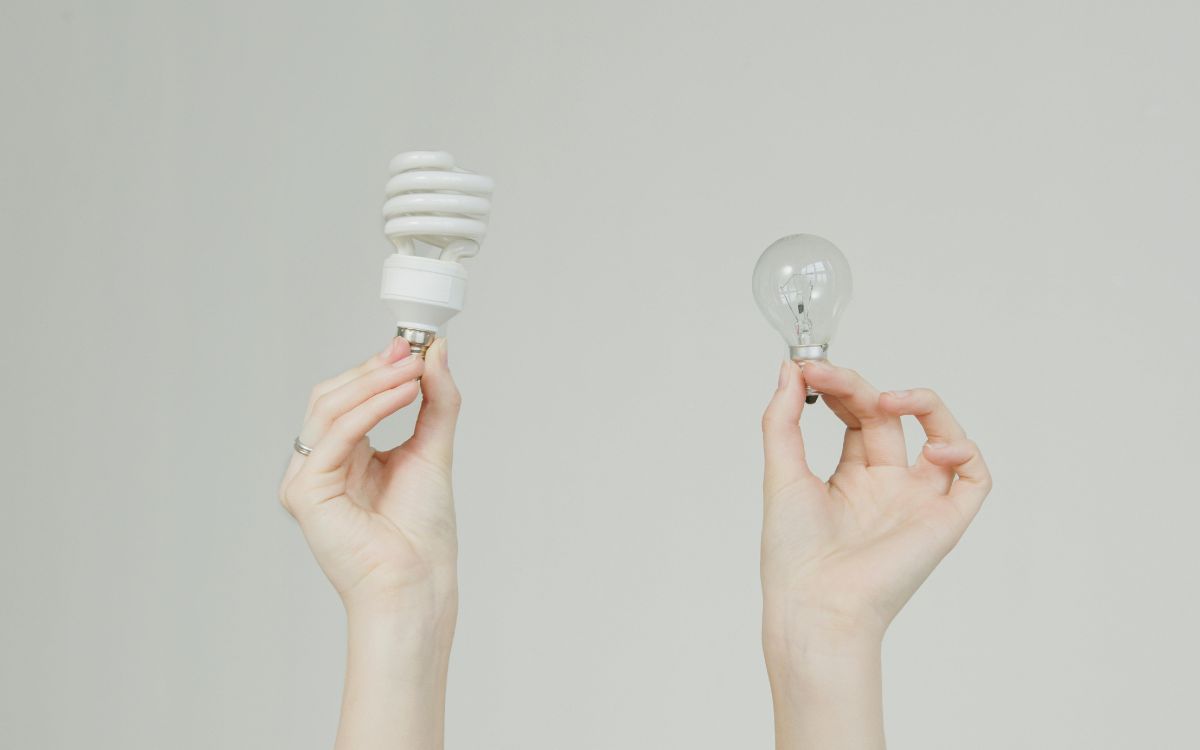
Fluorescent vs LED: real consumption per hour
| Technology |
Typical wattage |
Service life |
Output (lm) |
Efficiency lm/W |
| T8 fluorescent tube |
36-58 W |
8,000-15,000 h |
3,200 lm |
65-85 lm/W |
| LED equivalent |
18-22 W |
50,000 h |
3,200 lm |
140-160 lm/W |
A 58W fluorescent running 10 hours a day for 250 working days consumes 145 kWh per year. The equivalent 22W LED consumes 55 kWh. The difference: 90 kWh per light point per year. At a price of 0.17 €/kWh, that is 15.30 € in savings per luminaire per year on energy alone.
The LED vs fluorescent payback period for businesses typically occurs between 18 and 36 months, not counting the luminaire maintenance cost, which in installations with many fluorescents adds another significant layer of savings.
Sodium vapour vs industrial LED: the biggest difference
In industrial installations, the comparison changes scale. A high-pressure sodium vapour industrial high bay operates at 250-400W.
The equivalent LED high bay operates at 100-150W for the same illuminance level. The energy saving exceeds 60% per light point.
| Technology |
Wattage |
Service life |
Cold start |
Maintenance |
| 400W sodium vapour |
400W (+ ballast: ~440W) |
20,000 h |
5-8 min |
High (ballasts, igniters) |
| Industrial LED high bay |
150W |
50,000 h |
Instant |
Minimal |
The LED service life of 50,000 hours compared to 20,000 for sodium vapour means a direct reduction in replacements and maintenance stoppages.
How to calculate savings before investing
You do not need to wait for a quote to know whether the investment is viable. The ROI of switching to LED lighting can be estimated with three figures and a ten-minute calculation, ready to present with a solid return on investment.
Simple ROI formula for LED lighting
Annual saving (€) = No. of luminaires × (Current W - LED W) × Hours/year × kWh price
Payback period (years) = Total investment / Total annual saving
The total annual saving includes energy savings plus savings on luminaire maintenance costs (replacements, labour, stoppages). In installations with many light points, this second component can represent 20-35% of the total saving.
Practical example: 1,000 m² industrial warehouse
- Current installation: 40 high-pressure sodium vapour high bays at 400W
- Operating hours: 3,000 h/year
- kWh price: 0.17 €/kWh
- Proposed LED: 40 industrial LED high bays at 150W
Current consumption: 40 × 0.44 kW × 3,000 h = 52,800 kWh/year: 8,976 €/year
LED consumption: 40 × 0.15 kW × 3,000 h = 18,000 kWh/year: 3,060 €/year
Energy saving: 5,916 €/year
Estimated maintenance saving: 1,200 €/year
Total saving: ~7,116 €/year
With a reference investment of 12,000-15,000 € in industrial LED high bays, the LED investment payback falls between 17 and 25 months.
Do you have a warehouse with different characteristics? Request a personalised savings study and receive figures tailored to your installation.
Practical example: 200 m² office
- Current installation: 60 fluorescent panels of 2×36W (72W per unit)
- Operating hours: 2,500 h/year
- kWh price: 0.17 €/kWh
- Proposed LED: 60 LED panels at 40W
Current consumption: 60 × 0.072 kW × 2,500 h = 10,800 kWh/year: 1,836 €/year
LED consumption: 60 × 0.040 kW × 2,500 h = 6,000 kWh/year: 1,020 €/year
Energy saving: 816 €/year
Estimated maintenance saving: 300 €/year
Total saving: ~1,116 €/year
With an investment of 3,500-5,000 € in office LED panels, the payback falls between 3 and 4.5 years, within the typical range for this type of installation.

Payback period by type of installation
Business LED energy efficiency is not measured the same way in all environments. Annual kWh consumption, hours of use, and the installed technology determine how long it takes to recoup the investment.
Offices: payback in 18 to 36 months
Offices have moderate consumption levels, but continuous use (8-10 hours daily, 250 days) makes LED office energy savings in 2025 consistent. Payback typically falls between 18 and 36 months when replacing linear fluorescents or halogen downlights with LED panels or low-consumption LED spotlights.
Industrial warehouses: payback in 12 to 24 months
LED savings in industrial warehouses are the highest in absolute terms. Installations with sodium or mercury vapour high bays have very high consumption per light point. The differential with the industrial LED high bay can exceed 250W per luminaire.
With 3,000-5,000 operating hours per year, the industrial LED lighting electricity bill can be reduced by 60-70%. The LED investment payback in an industrial warehouse falls between 12 and 24 months.
Retail premises: payback in 24 to 48 months
Retail premises vary considerably. A supermarket or large retail space with continuous display lighting can achieve payback in 18-24 months. A premises with reduced opening hours will take longer, between 24 and 48 months. In any case, the improvement in light quality has an additional effect on product perception that marketing teams value.

Available grants and subsidies in 2025
The initial cost of an LED lighting profitability project improves when current funding lines and tax relief are factored in.
IDAE programmes for energy efficiency
The IDAE (Institute for Energy Diversification and Saving) manages IDAE energy efficiency grants through the Recovery, Transformation and Resilience Plan, as well as its own programmes such as the Energy Rehabilitation Aid Programme. LED lighting grants for businesses in 2025 can cover between 30% and 40% of eligible investment for SMEs, depending on company size.
Some programmes require a prior energy audit, which may also be eligible for funding. Specific calls and percentages vary by autonomous community, as part of the funds are managed regionally.
Tax deductions for efficiency investment
The Corporate Income Tax Act includes deductions for investments in energy efficiency, including LED lighting projects when they form part of a certified improvement in the building's energy expenditure.
The deduction can reach 30-40% of the investment depending on the accredited level of energy improvement.
To access it, the project must have an energy certificate both before and after the work. Companies that combine a direct grant with a tax deduction can reduce the net cost of the investment by more than half.
Before finalising the budget, it is worth checking with a tax adviser whether the project meets the requirements. In many cases, how much it costs to switch a business to LED lighting is considerably less than the list price.
Frequently asked questions about LED savings for businesses
How much does a company save by switching from fluorescent to LED?
Energy savings typically range between 50% and 70% of lighting consumption. For a company with 100 fluorescents operating 8 hours a day, annual savings can be in the region of 2,500-4,000 €, not counting maintenance savings.
How long does it take to recoup the investment in an industrial LED installation?
In industrial warehouses with sodium vapour high bays or similar, the industrial LED investment payback typically falls between 12 and 24 months. In some cases with high hourly loads, it can come in under 12 months.
Are there grants for switching to LED lighting in 2025?
Yes. The main routes are the IDAE energy efficiency programmes and regional grants linked to the PRTR. Additionally, deductions are available under corporate income tax. LED lighting grants for businesses in 2025 can cover between 30% and 40% of eligible investment for SMEs.
How do I calculate savings before making the investment?
Multiply the number of LED luminaires by the wattage difference in kW, by the annual hours of use, and by the business kWh price in 2025. Add the estimated saving on luminaire maintenance costs.
The result gives you the annual saving. Dividing the total investment by that figure gives you the payback period. You can also calculate business LED savings with the help of a specialist who audits the current installation.
Is LED maintenance really cheaper?
Yes. The LED service life of 50,000 hours compared to 8,000-20,000 hours for earlier technologies drastically reduces replacement frequency. In high-level installations (warehouses, sports halls, car parks), the saving on maintenance labour is particularly significant.
Which type of company benefits most from switching to LED?
The companies with the greatest return are those with installations running many daily hours and older technologies. LED lighting to reduce business costs is especially cost-effective in logistics, manufacturing, food production, and distribution. In offices and retail, the return takes slightly longer but the improvement in light quality delivers additional value.
Request a no-obligation personalised savings study. We analyse your installation, calculate the return on investment for business LED lighting, and present a proposal tailored to your specific situation. Request a personalised savings study.
Leave a comment