An interior decorator had been specifying SMD strips for every refurbishment for years. In the premises and homes where he installed them, they worked, they delivered and the client never complained. Until one job came along. He had to illuminate the display counters of a jewellery shop in central Madrid and, due to a stock issue, his supplier could only send him COB strips.
He installed them because he had no other choice, and the next day the jeweller called him. He said the rose gold rings looked like a completely different product, customers were spending more time looking at the display case and returns had disappeared. From that day on, that decorator knows very well when he needs a COB vs SMD LED strip. And you will be able to do the same after reading this article.
Choosing between these two LED technologies is not a trend. It is a matter of understanding what each one offers, where it performs best and how much you are willing to invest.
What is an SMD LED strip and how does it work
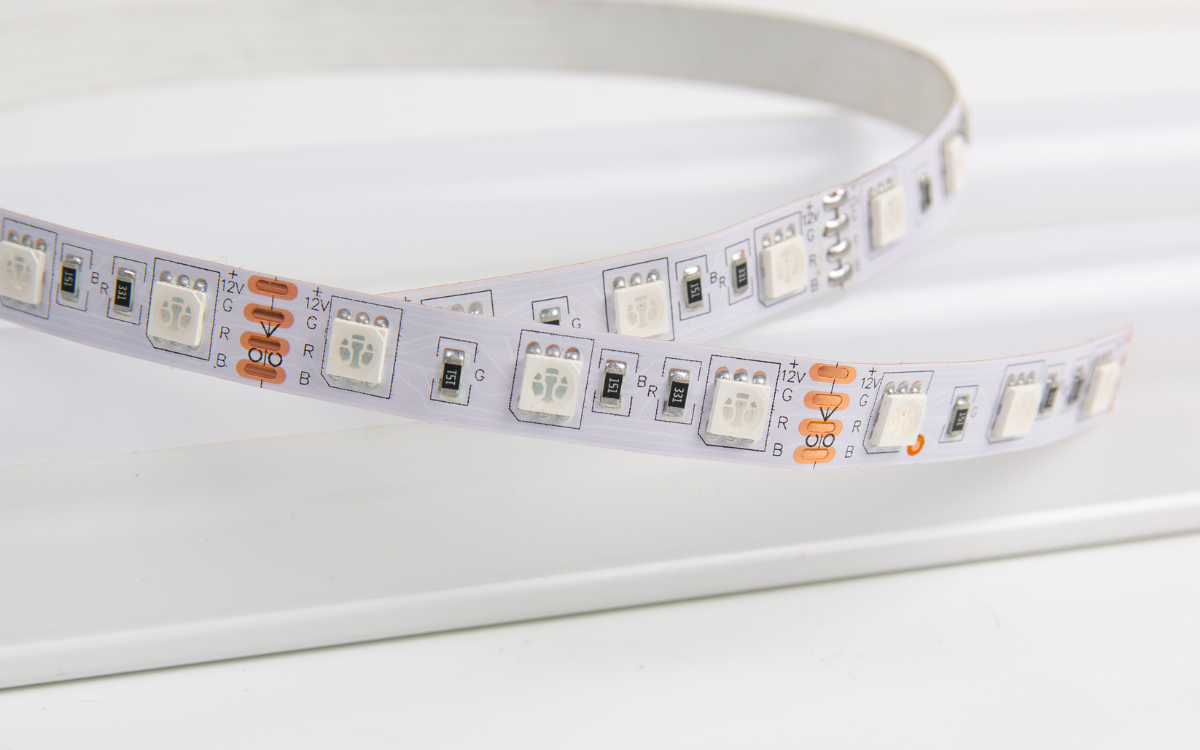
The SMD LED strip uses surface-mounted diodes individually soldered onto a flexible board. Each chip is separated from the next by a few millimetres, which creates a visible light dot pattern when the strip is observed up close or without a diffuser. It is the technology that has been on the market the longest and remains the most chosen option for decoration and general lighting projects.
Its operation is straightforward. The current reaches each chip through the tracks of the flexible printed circuit and each LED emits light independently. This is precisely what allows the creation of RGB, CCT and even RGBW versions with great per-channel control.

Most common SMD chip types (2835, 5050, 3535)
Not all SMD strips are the same. The number accompanying the chip indicates its dimensions in tenths of a millimetre and influences the wattage and type of use:
- SMD 2835: Compact chip measuring 2.8 x 3.5 mm. Highly efficient in lumens per watt. It is the most widely used for white lighting. The affordable SMD 2835 LED strip is the most common choice for large-scale installations on a good budget.
- SMD 5050: Chip measuring 5.0 x 5.0 mm. It can integrate three emitters within the same package, which makes it the basis for most RGB colour SMD LED strips and multi-channel versions.
- SMD 3535: This chip is less common in domestic strips but more usual in high wattage per metre solutions for professional or industrial use.
Advantages and disadvantages of SMD
SMD strips offer a highly competitive quality-to-price ratio in certain scenarios.
Advantages:
- Wide variety of chips, wattages and colours.
- Compatible with RGB, CCT and DALI or DMX dimming systems.
- Price per metre is more accessible.
- The CCT dimmable SMD LED strip allows colour temperature adjustment without changing the luminaire.
Disadvantages:
- Light dots are visible if no diffuser is used.
- CRI between 80 and 85 on standard models.
- Lower luminous uniformity compared to COB technology.
What is a COB LED strip and how does it differ
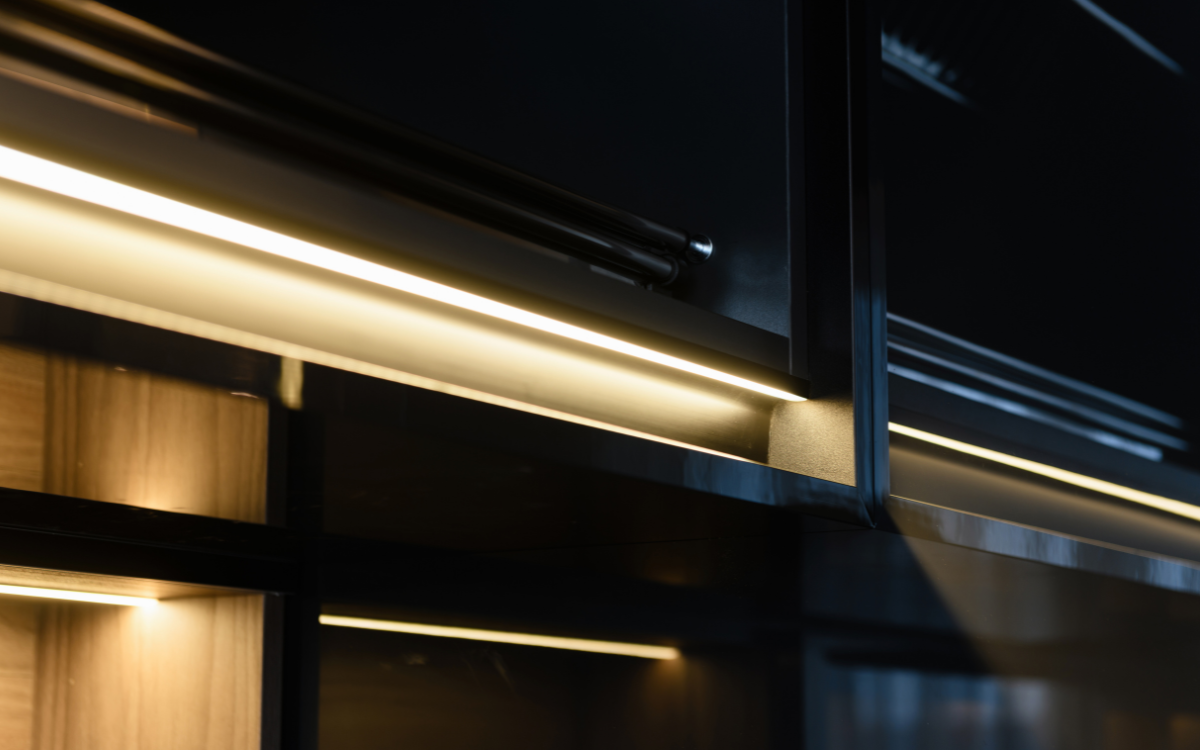
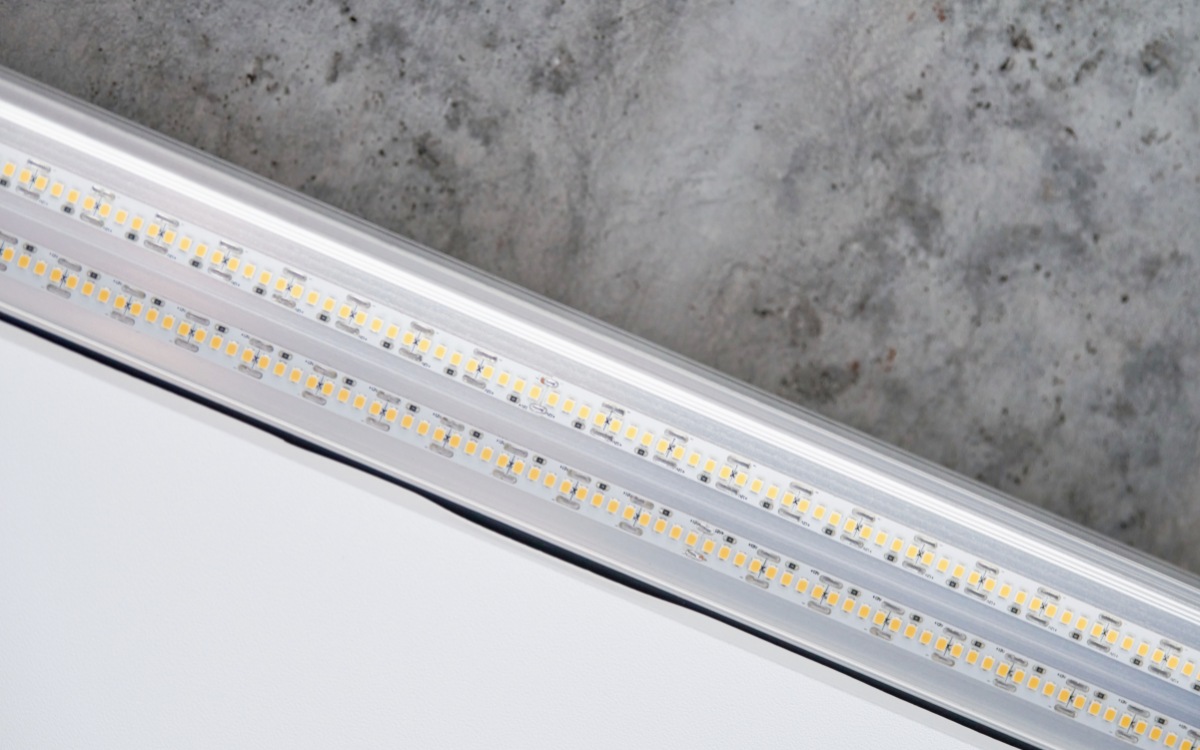
The COB LED strip. Instead of mounting individual chips separated from each other, it integrates hundreds of micro-diodes onto the substrate, covered by a continuous phosphor layer. The result is a homogeneous line of light without interruptions and without the separated dot effect found on SMD.
The choice between COB and SMD is largely a matter of decorative vs functional application. Whilst SMD dominates in ambience and colour effects, COB prevails where high light quality is non-negotiable.
Why no light dots are visible on a COB strip
It is down to density. A 320 LED per metre COB LED strip places the emitters so close together that the light merges into a continuous band. That is why a COB LED strip with no visible dots is ideal for aluminium profiles with a translucent cover, as the line it projects is clean, continuous and professional.
This characteristic makes the flicker-free continuous COB LED strip the preferred choice for installations where the strip is slightly exposed or where the human eye is very close to the light source.
CRI in COB strips: the advantage for demanding applications
The colour rendering index measures the extent to which a light source allows the true colours of an object to be perceived. Here COB wins by a wide margin. It is common to find CRI90 recessed COB LED strip models that reach values of 90 or even above 95 in professional ranges.
That level of CRI colour fidelity makes the difference in spaces where colour is everything. The uniform luminous density of COB reinforces that fidelity because it eliminates the shadow zones between chips that do appear on SMD.

Direct comparison: COB vs SMD
This table summarises the key parameters of the COB SMD LED strip differences:
| Parameter |
SMD LED Strip |
COB LED Strip |
| Visible light dots |
Yes (without diffuser) |
No |
| Typical CRI |
80–85 |
90–97 |
| LED density/m |
60–120 |
320–528 |
| Efficiency per metre |
High (up to 160 lm/W) |
High (up to 150 lm/W) |
| RGB options |
Wide range |
Limited |
| Average price per metre |
Low–medium |
Medium–high |
| Customisable cutting |
Every 5–10 cm |
Every 2.5–5 cm |
| Best application |
Decorative, colour |
Functional, accent, commercial |
Luminosity and efficiency per metre
In terms of lumens per watt, both LED technologies are very evenly matched. The best SMD 2835 strips can exceed 150 lm/W and the latest generation COB strips operate within similar ranges. The difference lies not in how much light they emit, but in how they distribute it. COB spreads the luminous density uniformly, whilst SMD concentrates peaks at each chip with small valleys between them.
Light quality and colour fidelity
An SMD 5050 decorative LED strip with CRI 80 is perfectly fine for a light cove in a living room or for backlighting a television unit. But place it in a clothing shop window and fabrics will lose their nuance. COB with CRI90 or above reproduces those nuances, and that translates into sales in commercial environments.
Price and quality-to-cost ratio
In the COB SMD LED strip price comparison, SMD is usually cheaper. However, COB requires fewer diffusion accessories to achieve a good finish, and its greater efficiency per metre in terms of quality reduces the need for additional lighting reinforcements.
When to choose a COB LED strip
COB excels in projects where visual comfort takes priority over budget.
Accent lighting and shop windows
A shop window needs the product to speak for itself. The 24V high-density COB LED strip in an aluminium diffuser profile generates a continuous line. It enhances textures, volumes and colours without distracting with light dots. This is the solution that an increasing number of interior designers recommend for mid-to-high-end retail.
Jewellery shops, opticians and spaces with colour-critical requirements
The COB LED strip for jewellery shops. A titanium mount loses its tone under a CRI of 80.
The question of COB vs SMD LED strip for commercial lighting answers itself when the customer needs to see the product as it truly is.
When to choose an SMD LED strip
SMD is not chosen simply because it is cheap. It is the smart option in many cases.
RGB colour decoration and ambiences
If the project requires colour, effects or synchronisation with music, the RGB colour SMD LED strip is an excellent option. The 5050 RGB and RGBW versions allow millions of combinations and are compatible with most controllers on the market. To know when to use a COB LED strip, first rule out whether you need colour — if the answer is yes, go straight for SMD.
Projects with a tight budget
A home refurbishment with light coves in the living room, bedroom and kitchen can easily add up to 30 or 40 linear metres. In those cases, the affordable SMD 2835 LED strip maintains quality at a good cost. And with an optical diffuser in the profile, the dot effect is notably minimised.

Essential accessories for each type
Even the best strip will not perform well without the right accessories. This applies to both COB and SMD.
Recommended aluminium profiles and diffusers
The aluminium diffuser profile serves three functions: it dissipates heat, protects the strip and diffuses the light. For COB strips, a profile with an opal cover is sufficient to achieve a perfect line. The COB LED strip with aluminium profile is virtually mandatory in exposed or semi-recessed installations. For SMD, the diffuser is more important as it softens those individual dots.
- The recessed profile is ideal for plasterboard ceilings and furniture.
- The surface-mounted profile is quicker to install on shelves and cornices.
- The corner profile achieves 45-degree accent lighting.
Compatible power supplies and controllers
Both COB and SMD operate at 24V, although 12V versions exist. The power supply must be sized at least 20% above the total consumption of the installation. For dimmable strips, a CCT dimmable SMD LED strip requires a compatible controller, whilst RGB requires an RGB or RGBW controller.
- 24V waterproof power supplies (IP67) for outdoor use.
- 24V ventilated power supplies for indoor installations with large metreage.
- Wi-Fi, RF or DALI controllers depending on the level of home automation integration.
Frequently asked questions about COB and SMD LED strips
Does a COB LED strip give more light than an SMD?
Not necessarily. In terms of lumens per watt, both technologies are very evenly matched. The difference lies in the fact that COB distributes light uniformly and continuously, whilst SMD concentrates the emission at each individual chip.
Can I install a COB strip outdoors?
Yes, provided you choose a model with IP65 or IP67 protection and a waterproof power supply. The strip should be protected inside a suitable profile to prevent degradation from moisture and UV radiation.
What CRI do COB LED strips have?
Standard models start at CRI90. Professional ranges reach CRI95 or even 97, making them an excellent option for commercial, healthcare and artistic spaces.
Are SMD RGB LED strips compatible with any controller?
Most standard RGB strips work with 3 or 4-channel controllers (RGB or RGBW). It is advisable to check the voltage and maximum amperage per channel. Wi-Fi and Zigbee controllers expand home automation integration options.
Which aluminium profile do I need for a COB strip?
It depends — for recessing into ceilings or furniture, a recessed profile with an opal cover. For surface mounting, a surface profile. The important thing is that the internal width of the profile is compatible with the customisable cutting of the strip.
Can a COB LED strip be cut to size?
Yes. COB strips incorporate cut marks every 2.5 or 5 cm depending on the model. The strip should always be cut whilst disconnected and along the indicated line.
Now that you know the COB SMD LED strip differences, the decision depends on your project. If you are looking for colour fidelity, a continuous line and a professional finish, COB is the way to go. If you need colour, RGB versatility or to cover large areas at a good price, SMD is an excellent lighting solution.
Leave a comment
Comments
Ruban LED RGBW
By: Martinez On 05/05/2026Bonjour, je n’arrive pas à trouver vos rubans RGB W au mètre linéaires