7 LED Lighting Keys for Clothing Shops That Want to Sell More


A fashion designer opened her first shop in the centre of Valencia on a very tight budget. To cut costs she installed cheap spotlights with no specified CRI and cool 6500K light. The garments looked dull, the colours didn't match what customers had seen on the website, and returns started piling up.

Six months later she redid the entire LED clothing shop lighting with CRI92 track spotlights at 3000K. Returns dropped by 40%. And her customers began saying something every brand wants to hear: the clothes look better here than in the photos.

That experience sums up what many retailers discover the hard way: light doesn't decorate, it sells. Or it drives people away. This article covers the 7 keys that separate a well-lit fashion shop from one that loses sales without knowing why.

Why lighting directly influences fashion sales

The human eye makes purchasing decisions before the brain rationalises them. Light affects how a fabric, a colour and even the apparent quality of a garment are perceived. A poorly executed fashion retail lighting design can sink the conversions of a premises that has good product and a good location.

Studies on shopper behaviour and light

Research published by the Journal of Retailing confirms that lighting affects dwell time in store and the perceived quality of the product. Spaces with a well-calibrated sales area lux level and coherent colour temperature record up to 30% more dwell time. The customer's visual adaptation upon entering the premises is the first filter: if the light is uncomfortable or distorts colours, the journey is cut short.

The difference between a well-lit shop and a bright one

More light does not mean high-quality light. A shop saturated with lumens produces high UGR glare, visual fatigue and a flat feeling that kills the volume of garments. What works is combining layers of light with intention: general lighting vs accent lighting, each with its own role. General lighting provides visual comfort and accent lighting creates the product spotlight effect that directs the eye towards what you want to sell.

Key 1 – Choose the right CRI so colours look real

The colour rendering index determines whether a red looks red or appears brown under your lighting. In fashion, where the colour palette defines entire collections, the textile colour rendering CRI is a figure you cannot ignore.

Minimum CRI recommended for fashion shops

For a clothing shop, the professional minimum is CRI 90. Below that, the nuances between similar fabrics are lost and customers buy something that later doesn't resemble what they saw in store. CRI90 LED spotlights for clothing shops with values of 92 or 95 are the benchmark used by mid-to-high-end retail chains. If you sell garments with natural dyes, embroidery or complex prints, don't go below 93.

Key 2 – Define the colour temperature according to your brand

The textile shop colour temperature is an extension of your brand identity. A designer boutique is not lit the same way as a streetwear shop.

Warm light for premium brands and boutiques

The warm vs neutral light clothing shop debate is almost always settled in favour of warm tones when the positioning is premium. A warm colour temperature of 3000K wraps the space, adds warmth to fabrics and creates a more intimate shopping experience. LED boutique lighting from luxury firms rarely exceeds 3000K. That was exactly the temperature that saved the Valencia shop.

Neutral light for contemporary and sportswear shops

Young, urban or sportswear brands usually fit better with 4000K. That type of neutral white light conveys modernity, cleanliness and energy without reaching the clinical coldness of 6500K. LED lighting for fashion shops selling sportswear or casual wear works well in this range, because it reproduces colours faithfully without taking dynamism away from the space.

Key 3 – Combine general and accent lighting

A single layer of light flattens the shop. The secret of luminous visual merchandising lies in layering ambient light vs accent task light with controlled ratios. General light ensures a comfortable base level for moving around. Focal accent lighting highlights specific products: mannequins, seasonal tables or front-facing rails.

How many lux you need in each zone

The clothing shop lux illuminance level varies by zone:

  • General sales area: 300–500 lux.
  • Window display: 1000–2000 lux, which must compete with natural light outside.
  • Fitting rooms: 300–400 lux, well distributed.
  • Cash desk: 400–500 lux.
  • LED lighting for wall or island rails: focal reinforcement of 2:1 or 3:1 relative to the general level.

The ratio between general and accent light usually falls between 1:3 and 1:5. If the general level is 300 lux, the spotlight on a mannequin can be between 900 and 1500 lux to create contrast without harshness.

Key 4 – Use adjustable track systems

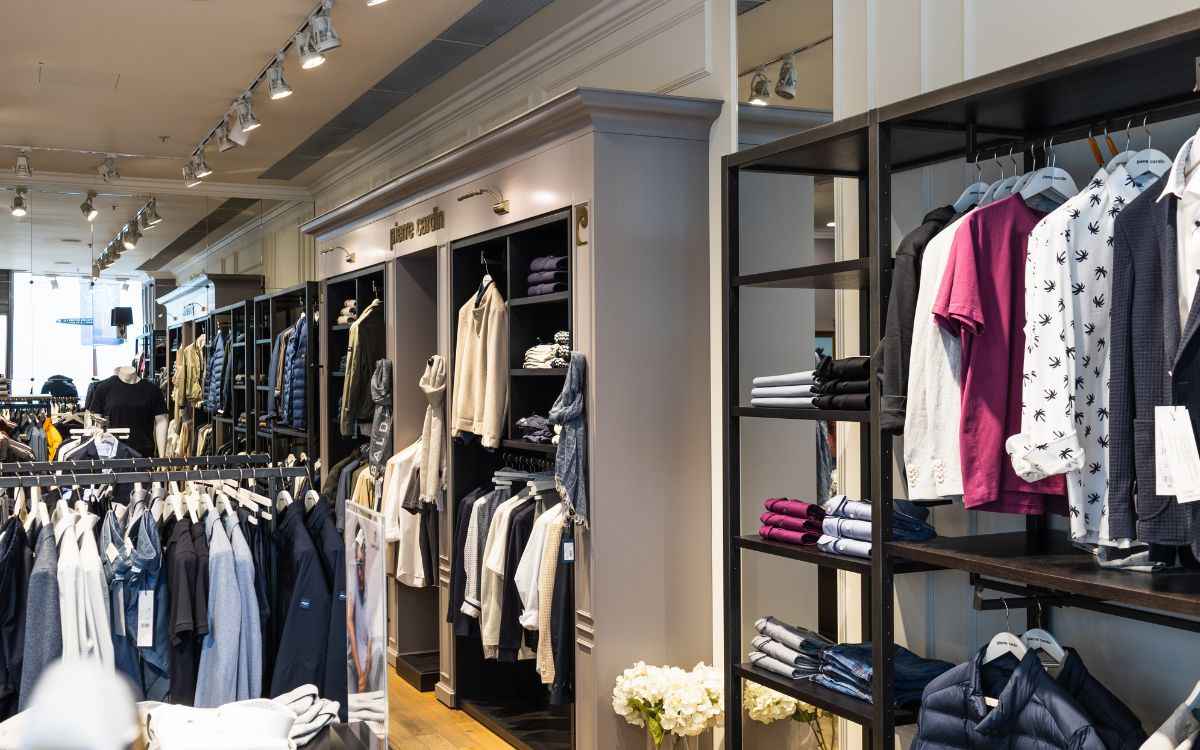
The LED track for clothing shops is the most flexible system for retail. It allows you to move, add or redirect spotlights every time the product layout changes or a new collection arrives. Adjustable fashion shop spotlights mounted on track are the standard tool of interior designers specialising in retail.

Three-phase vs single-phase track in retail

The choice between three-phase textile shop spotlights and single-phase depends on the complexity of the project:

  • Single-phase track: one circuit. All spotlights switch on and dim together. Suitable for small shops with a single lighting scene.
  • Adjustable three-phase track: three independent circuits on the same track. It allows you to switch on general light, accent light and a third scene separately. Ideal for medium and large shops where visual merchandising changes frequently.

The adjustable three-phase track offers far greater versatility for creating differentiated scenes without running extra cable.

Key 5 – Light the window display correctly

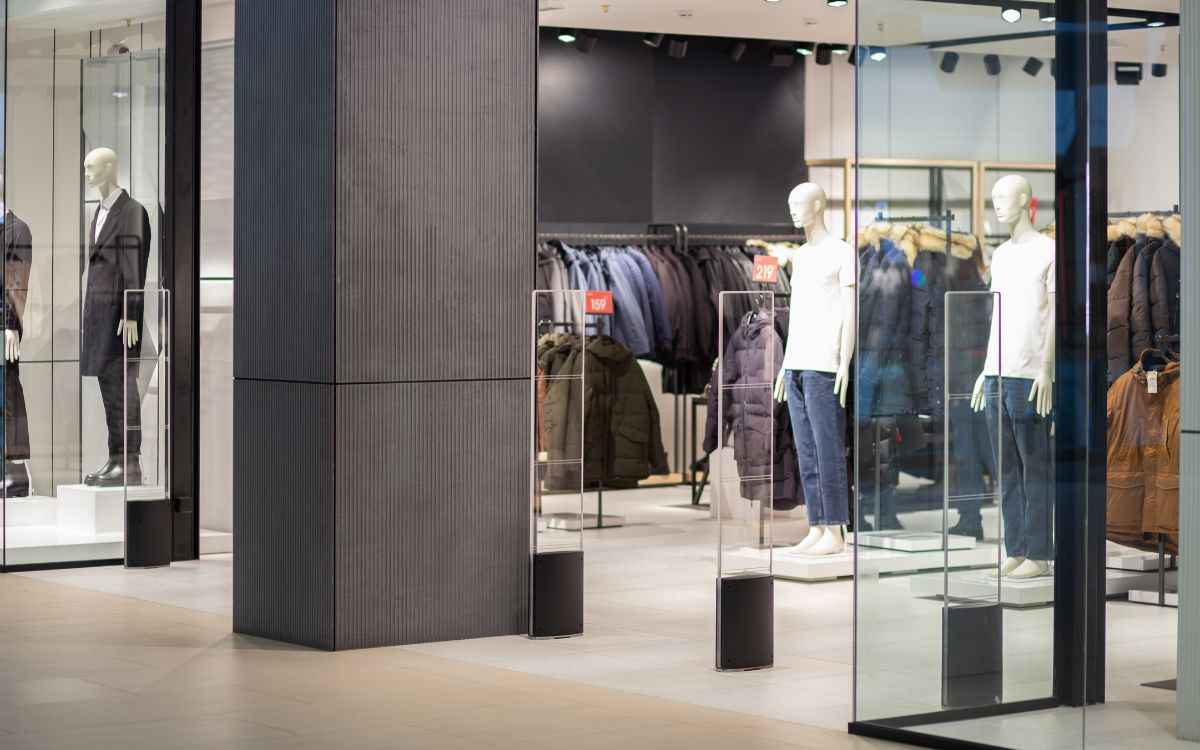
The window display is your best silent salesperson. If the LED light for clothing window displays isn't properly resolved, the customer walks straight past. Window display lighting competes against direct sunlight, street reflections and the viewing distance.

Recommended spotlights and angles for window displays

LED lighting for window mannequins needs spotlights with a beam angle between 15° and 24° to create a clean spotlight effect. The output must guarantee a minimum of 1000 lux on the product during daytime. A common mistake is lighting the window from above with a single beam angle. The correct approach is to combine:

  • A main overhead spotlight with a 15–20° beam on the focal point.
  • Side or fill spotlights with a wider beam of 36–40° to fill in shadows.
  • Avoiding light hitting the glass, because it creates reflections that cancel visibility from outside.

Key 6 – Don't neglect the fitting room

It is the most decisive zone and the most neglected. This is where the purchase decision is made or abandoned. Poor LED fitting room lighting creates shadows on the face, distorts colour and makes the customer look worse than they are. And that kills the sale.

Flattering light: the right temperature and direction

The key in the fitting room is to avoid direct overhead light as the sole source. That emphasises dark circles, accentuates imperfections and casts shadows under the chin. What works:

  • Front-side lighting on both sides of the mirror, at face height.
  • Temperature of 3000K–3500K for a tone that flatters the skin.
  • Minimum CRI of 90 so the colour of the garment inside the fitting room matches what is seen in the sales area.
  • Output of 300–400 lux with no peaks or dark spots.

A well-lit fitting room is the difference between a sale and a garment left on the rail.

Key 7 – Plan maintenance and efficiency

How to light a clothing shop doesn't end with the installation. The total cost includes consumption, replacement and maintenance. This is where LED dominates compared with previous lighting technologies.

LED vs halogen in total cost for retail

An average shop of 80 m² with 30 halogen track spotlights at 50W consumes around 1500W on accent lighting alone. Those same light points with 25W LEDs drop to 750W. But the difference lies in the lifespan:

  • Halogen: 2000–3000 hours. Lamp changes every 6–8 months.
  • LED: 30,000–50,000 hours. Up to 10 years without replacement in standard commercial use.

Multiplied by the price of each lamp, the labour cost of changing them and the time spent with blown spotlights, LED pays for itself. This usually happens within 12 to 18 months in most textile shops. On top of that, LED emits less heat, which reduces the air conditioning load in summer.

Frequently asked questions about lighting for clothing shops

What minimum CRI does a clothing shop need?

CRI 90 as a minimum. For shops with complex-coloured garments or natural fabrics, a CRI of 93–95 is best. Below 90, nuances are lost and returns due to colour differences increase.

What colour temperature is best for a fashion boutique?

3000K for premium boutiques and brands with warm positioning. 4000K for sportswear, youth or contemporary shops. Brand temperature is as important as the logo for creating a welcoming atmosphere.

How many lux are recommended in a textile shop?

Between 300 and 500 lux in the general sales area. The window display needs between 1000 and 2000 lux to compete with natural light. Fitting rooms, between 300 and 400 lux with uniform distribution.

Is three-phase or single-phase track better for clothing shops?

Three-phase offers three independent circuits on a single track, allowing you to manage different lighting scenes without extra cabling. For medium and large shops, it is the most versatile option. Single-phase is reserved for very small premises with a single scene.

How should I light a fitting room so the light is flattering?

With front-side lighting on both sides of the mirror, at face height. Temperature between 3000K and 3500K, minimum CRI of 90 and no overhead spotlights as the sole source. The aim is to eliminate harsh shadows and make the customer look good.

How many track spotlights do I need per square metre in a shop?

As a general reference, 1 spotlight every 3–4 m² for accent lighting. General lighting is handled with recessed or linear luminaires. The exact number depends on the wattage of each spotlight, the ceiling height and the target lux level.

 
Posted in: Sample Category

Leave a comment

★
★
★
★
★
Security code
Blog navigation

Latest posts

Outdoor Lighting Trends for Summer 2025: What's In This Year

This summer's outdoor lighting trends bet on less light, better distributed and with more personality. We review six...

Read more
LED Lighting for Sports Facilities: Regulations and Professional Solutions

LED lighting for sports facilities requires uniformity, low glare and compliance with the UNE-EN 12193 standard. This...
Read more
European Energy Efficiency Regulations in LED Lighting: What You Need to Know in 2025

European energy efficiency regulations changed the rules for professional LED lighting. This guide summarises which...
Read more
RGB and CCT LED Controllers: What They Are, How They Work and Which One You Need

RGB and CCT LED controllers are the piece that decides the colour, brightness and temperature of your LED strip. We...

Read more
The 8 Best Selling LED Luminaires for Commercial Premises and Why They Work

Guide to LED luminaires for commercial premises with the eight models installers repeat most in shops and businesses,...

Read more